Vinyl Record Display Ideas: Wall Mounts, Flip-Through Stands & Creative Ways to Show Off Your Collection
Share
Vinyl Record Display Ideas: Wall Mounts, Flip-Through Stands & Creative Ways
37% of Gen Z use vinyl as home decor. 56% buy it for aesthetics. Here are the wall mounts, frame stands, and flip-through bins that turn album art into the focal point of the room.
- Solid wood
- Modular & stackable
- Free worldwide shipping
- 30-day returns
Key takeaways
- Album art IS the decor. 37% of Gen Z use vinyl as home decor. Show off the cover, not just the spine.
- Front-facing display = identity. Frame your "shelf queens" — the rare records you don't play but want seen.
- Flip-through bins recreate the store ritual. Batea-style bins let guests browse like in a record shop.
- Solid wood frames don't warp the record. Plastic frames + sunlight = warp. Wood + rotating display = preserved.
- Climate still matters. Even displayed records need 65–72°F (18–22°C) and 35–55% RH.
Audiophile forums are full of jargon that sounds precise but often obscures simple concepts. Terms like "warmth," "staging," "soundstage," and "presence" are useful descriptors—but only if you understand what they're actually referring to.
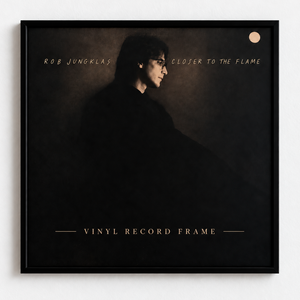
Some records are too good to hide. The covers that started everything — display them like the art they are.
The problem is that audiophile language evolved in isolation, without standardization. Different people use the same terms to describe different things. One person's "bright" is another person's "detailed." You can read dozens of reviews and come away confused about what people are actually hearing.
Recommended
our complete vinyl wall display guideFlying V, Vinyl Break, and Modular Foreigner wall mounts.
Display Without Damage
The best display solutions protect records while showcasing them. Wall mounts that distribute weight evenly prevent ring wear, while stands that support the spine keep the jacket flat. With 56% of collectors valuing vinyl as decoration and 37% treating records as wall art, purpose-built display solutions are essential for collectors who want to show off their favorites without risking damage.
I'm going to break down the terminology that matters, what these terms actually mean physically, and how to translate between the way people talk about sound and what's actually happening in your music.
Frequency Range and Tone
Brightness / Presence / Brilliance: These all point to emphasis in the high frequencies. When someone says a system is "bright," they mean there's more energy in the treble (the highest notes). This can feel energetic and detailed, or it can feel harsh and fatiguing—it depends on how much emphasis and whether it's balanced with the rest of the spectrum.
Flying Vinyl wall-mounted record display showing album covers — Shop now
Darkness / Warmth / Bass-heavy: These indicate emphasis in the low frequencies. "Warm" specifically suggests a smooth, rounded bass response that feels comforting. "Dark" usually means less treble emphasis, which can sound smooth but might also sound dull if taken too far.
Midrange presence: The midrange is 200Hz to 3kHz—where human voices and most instruments live. A system with strong midrange feels intimate and vocal-forward. Systems that have a "V-shaped" response (bass and treble emphasized, midrange recessed) can sound exciting but make vocals sound distant.
Neutral / Flat / Linear: These terms describe a system that amplifies all frequencies equally, without emphasis or de-emphasis. This is technically ideal for accurate reproduction, but in practice, pure neutrality can sound clinical to human ears.
Spatial Characteristics
Soundstage / Imaging / Staging: These describe where you perceive sounds coming from. "Wide soundstage" means the music appears to come from speakers far apart. "Deep soundstage" means you perceive sounds as coming from behind the speakers. "Imaging" is the precision of that localization—whether you can pinpoint exactly where a vocalist is positioned.
These characteristics are mostly determined by headphone design, speaker placement, and room acoustics. They're not inherent to the recording unless you're listening to deliberately mixed surround content.
Separation / Definition: These describe how clearly you can distinguish individual instruments in a mix. Good separation means you can pick out the bass guitar, drums, and vocals as separate entities rather than a blur of sound.
Coherence / Cohesion: The opposite problem—when all the instruments blend together smoothly. This can sound musical and integrated or it can sound muddy, depending on context.
Dynamic Characteristics
Attack / Decay: "Attack" describes how quickly sound reaches full volume when a note starts. A fast attack sounds snappy and immediate. A slow attack sounds softer, rounded. "Decay" is how quickly sound fades away. These vary by instrument—drums have fast attacks, strings have slower ones.
The Digger's Wall vinyl record display shelf on a living room wall — Shop now
Transients / Transient response: The ability of a system to accurately reproduce fast changes in volume. Good transient response means drums sound punchy, hi-hats sound crisp. Poor transient response means everything sounds rounded and soft.
Dynamics / Dynamic range: The difference between the quietest and loudest parts of a recording. A system with good dynamic range can reproduce both whispered vocals and loud drums with equal clarity, without the quiet parts disappearing or the loud parts distorting.
Punch / Impact: Perception of weight and force in the bass. A system with good punch makes kick drums feel powerful without necessarily being loud.

Texture and Timbre
Grain / Grainy: Perception of surface texture in the sound. A "grainy" system reveals lots of detail in the recording, but can sound harsh if there's too much. Think of it as the audio equivalent of a high-resolution photo where you see every skin pore.
Smoothness / Smooth / Rolled-off: The opposite—when high-frequency details are muted, creating a polished, refined sound. Can sound pleasant or can sound like detail is being hidden.
Clarity / Clearness: How transparent the system is—how much of the recording you can actually hear. A clear system reveals layers of sound that a less clear system masks.
Tone / Tonality: The inherent character of the sound—whether it sounds more like real instruments or more like electronic artifacts. A system with good "tone" makes instruments sound like their real-world equivalents.
Technical Terms You'll Encounter
THD (Total Harmonic Distortion): Unwanted harmonics added to the signal. Lower is better, but below about 1%, most ears can't perceive it. This is a technical measurement, not a listening experience.
SNR (Signal-to-Noise Ratio): The difference between the signal and background noise. Higher is better. In practice, unless you're hearing noise, SNR is fine.
Impedance: Electrical resistance. Matters for compatibility between components but doesn't directly affect sound character.
Frequency response: How a system amplifies different frequencies. "Flat" frequency response is ideal, but in practice, humans prefer a slight V-shape (bass and treble boost).
The Takeaway
Audiophile terminology exists because sound is complex and human perception is subjective. But most of these terms describe specific, measurable phenomena—frequency emphasis, spatial positioning, dynamic response, and detail retrieval.
When reading reviews, try to identify what the reviewer is actually describing rather than taking their conclusions at face value. Is it a frequency emphasis? A spatial characteristic? Good that way you can decide if it's something you actually want to hear.
Bass Emphasis

Lower frequencies emphasize warmth and punch.
Midrange Presence
Mid frequencies bring intimacy and vocal clarity.
Treble Clarity
High frequencies reveal detail and brilliance.
Dynamics
Range between quiet and loud for vivid music.
Related Articles

Find the perfect home for your turntable
See Turntable Stands
For a complete overview of every storage type, read our best vinyl storage options guide.
Related Reading
Ready to display your collection?
The Flying V Wall Display holds up to 50 LPs and turns your records into wall art. See all wall displays → For a deeper look, check out our vinyl wall mount guide.
Continue exploring
Album Art Belongs on Display.
Wall mounts and steel stands that showcase your collection as art. Solid wood, easy install.
Shop Wall Mounts →Vinyl Break StandWall Mount vs Flip-Through Stand vs Floating Shelf vs Picture Frame
| Feature | KTS Wall Mount | Flip-Through Stand | Floating Shelf | Acrylic Frame |
|---|---|---|---|---|
| Shows album art | Front-facing | Top record visible | Spines visible | Front-facing |
| Capacity | 1–4 records | 30–60 LPs | 10–20 LPs | 1 record |
| Material | Solid wood | Solid wood | Wood/MDF | Plastic |
| Warp risk for record | None | None | Lean = warp | Sun + plastic |
| Aesthetic | Gallery quality | Record store | Generic | Decorative |
Built for the real weight of vinyl
KTS solid-wood storage is engineered to hold 200, 500, or 1,000+ LPs without sagging. Modular, stackable, made in Spain.
See Wall MountsCommon questions
Frequently Asked Questions
Can IKEA Kallax hold the weight of a full record collection?
No. IKEA rates each Kallax shelf for 13 kg max. A single cube fully loaded with 80–90 records weighs 16–18 kg — you're overloading the shelf by 25–40% from day one.
How much does a collection of 100, 500, or 1,000 records weigh?
Based on standard 120–150 g records: 100 LPs ≈ 12–15 kg, 200 LPs ≈ 25–30 kg, 500 LPs ≈ 65–75 kg, 1,000 LPs ≈ 130–150 kg. Audiophile 180–220 g pressings weigh ~25% more.
Is solid wood strong enough for heavy records?
Yes. has one of the best strength-to-weight ratios of any timber — nicknamed "the aluminium of wood." High dimensional stability, low shrinkage, excellent load resistance.
How do you display vinyl records on a wall?
Does displaying vinyl records damage them?
Continue exploring
Find your perfect setup
Your album art is wall art
Solid-wood wall mounts, flip-through stands & display systems. Frame your records like the art they are. Made in Spain.