

Vinyl Record Dimensions — Sleeve Sizes, Weight & Protection Guide
Quick Answer
Standard vinyl record sleeve dimensions: 12-inch LP sleeve = 31.43 × 31.43 cm (12.375 × 12.375 in). The record itself is 30 cm (11.81 in). 10-inch EP sleeve = 26.67 cm. 7-inch single sleeve = 18.42 cm. Inner sleeves are slightly smaller to fit inside the outer jacket. For best protection, use polyethylene-lined inner sleeves + polypropylene outer sleeves — this prevents ring wear and static buildup.
Dimensions That Define Your Storage Needs
Knowing exact sleeve dimensions is the first step to choosing the right storage. A standard 12-inch LP in its jacket measures 31.5 x 31.5 cm, but gatefold sleeves can reach 32.5 cm or wider. Box sets push even further. Storage systems designed for generic shelving often leave too little clearance, forcing you to jam records in and risk ring wear on the covers. Purpose-built vinyl furniture accounts for these variations with 33+ cm internal width, proper vertical support to prevent leaning, and modular expansion so your storage grows with your collection — from 50 records to 500 and beyond.
Vinyl Record Dimensions — Sleeve Sizes, Weight & Protection Guide
Vinyl record dimensions come in three standard sizes: 7-inch singles (175 mm disc / 184 mm sleeve), 10-inch EPs (250 mm disc / 260 mm sleeve), and 12-inch LPs (300 mm disc / 315 mm sleeve). Every one of the 46.8 million records sold in the US last year shipped in one of these formats — and most collectors never think twice about whether the sleeve is actually doing its job. A sleeve too tight warps the jacket; one too loose lets dust abrade the grooves. With the average Discogs collection at 195 records (roughly 50–60 kg of vinyl), getting vinyl record dimensions and sleeve fit right isn't a minor detail — it's basic collection hygiene.
This guide covers every standard size, material option, and fit consideration so you can protect your vinyl properly — whether you've got 20 records or 2,000.
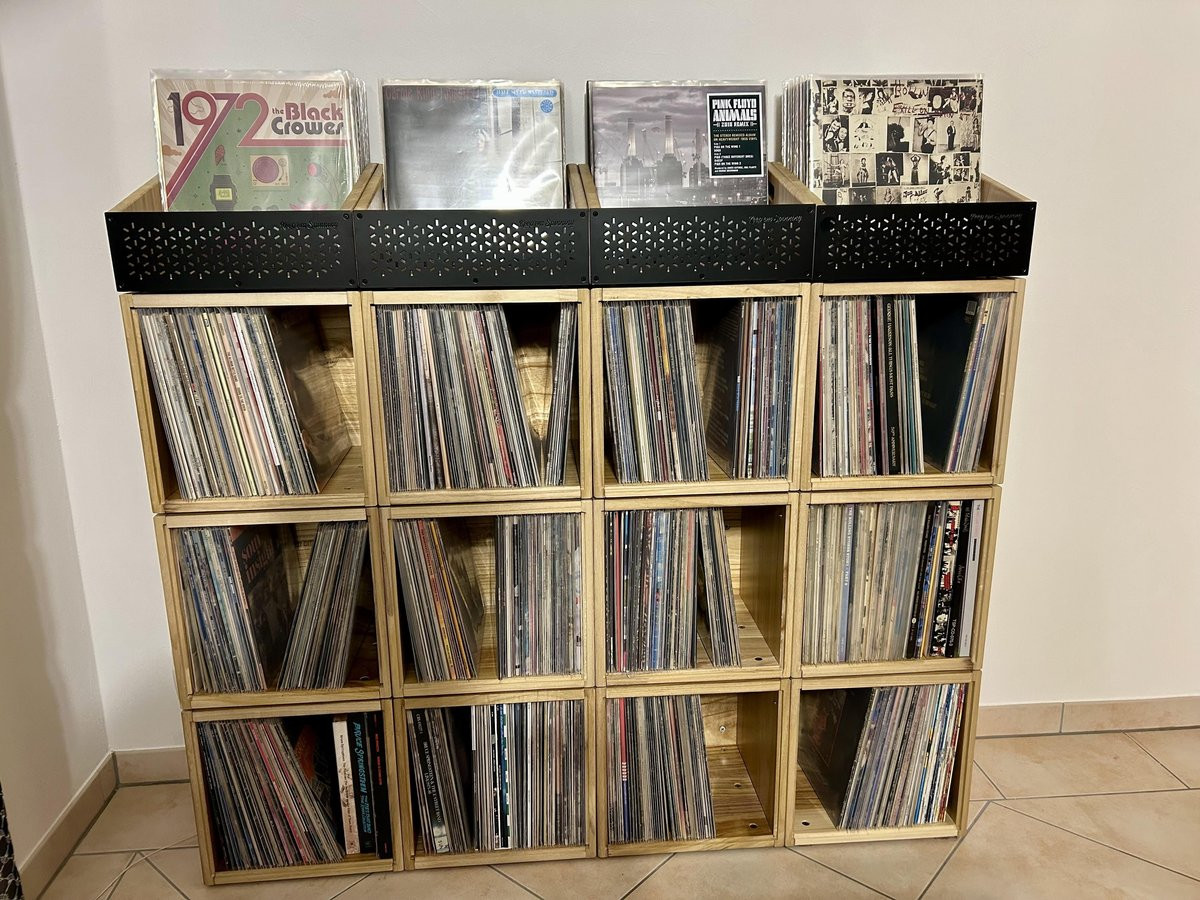
Standard Vinyl Sizes and Their Sleeve Dimensions
standard size of vinyl record cover — Explore our selection of standard size of vinyl record cover, vinyl record cover dimensions, LP cover size. Keep Them Spinning offers sustainable solid Paulownia wood solutions purpose-built for vinyl record collections.
Vinyl Record Dimensions — Complete Reference Table
Understanding vinyl record dimensions is essential for choosing the right storage, framing, and shipping solutions. The three standard vinyl record sizes — 7-inch, 10-inch, and 12-inch — each have specific dimensions that include the record itself, the inner sleeve, the outer sleeve, and the total package with any inserts or gatefold covers.
Standard Vinyl Record Sizes and Dimensions
The 12-inch LP is the most common format. The record itself measures 12 inches (30.48 cm) in diameter. With a standard inner sleeve, the package is approximately 12.375 x 12.375 inches (31.43 x 31.43 cm). A gatefold cover adds width: expect 12.5 x 25 inches (31.75 x 63.5 cm) when fully opened. The standard outer protective sleeve for a 12-inch record is 12.75 x 12.75 inches (32.4 x 32.4 cm).
The 7-inch single measures 7 inches (17.78 cm) in diameter. With sleeve, the package is approximately 7.25 x 7.25 inches (18.4 x 18.4 cm). The standard outer sleeve for 7-inch records is 7.5 x 7.5 inches (19.05 x 19.05 cm).
The 10-inch record — the original 78 RPM format and still used for some special releases — measures 10 inches (25.4 cm). With sleeve: approximately 10.375 x 10.375 inches (26.35 x 26.35 cm). Outer sleeve: 10.75 x 10.75 inches (27.3 x 27.3 cm).
Why Vinyl Record Dimensions Matter for Storage
Every millimeter counts when designing vinyl record storage. A shelf that is 12 inches deep cannot properly accommodate 12-inch LPs with outer sleeves (which need 12.75 inches minimum). Most generic bookshelves are 11 inches deep — meaning your records stick out the front, unprotected and at risk of falling. Our vinyl record storage furniture is dimensioned for the full package: record + inner sleeve + outer sleeve + clearance for easy browsing, with shelf depths of 13.5-14 inches to accommodate even gatefold double LPs.
Record Cover Dimensions for Framing and Display
The standard vinyl record cover measures 12.375 x 12.375 inches (31.43 x 31.43 cm). For framing, use frames with an opening of at least 12.5 x 12.5 inches. Standard photo frame sizes (12x12, 13x13) work if you want a tight crop. For wall-mounted vinyl display, our mounts accommodate the full cover dimension with clearance for easy insertion and removal.
Vinyl records come in three standard diameters, and each one has corresponding sleeve and jacket sizes designed to provide a snug, protective fit.
7-inch singles (45 RPM) — The record itself is 7 inches (178 mm) in diameter. Standard paper sleeves for 7-inch singles measure approximately 7.25 × 7.25 inches (184 × 184 mm). Outer jackets, when used, run about 7.5 × 7.5 inches (190 × 190 mm). These are the most compact format and the easiest to store in quantity.
10-inch records (78 RPM / some LPs) — The disc measures 10 inches (254 mm). Inner sleeves sit around 10.25 × 10.25 inches (260 × 260 mm), and outer jackets are roughly 10.5 × 10.5 inches (267 × 267 mm). This format saw heavy use in the 78 RPM era and has made a modest comeback for special editions — 38% of collectors now prefer limited-edition packaging, and 10-inch pressings are a favorite for premium reissues.
12-inch LPs (33⅓ RPM) — By far the most common format in modern collections. The disc is 12 inches (305 mm) across. Inner sleeves measure about 12.25 × 12.25 inches (311 × 311 mm), and outer jackets are typically 12.375 × 12.375 inches (314 × 314 mm). Gatefold jackets, which open like a book, measure roughly 12.375 × 24.75 inches when fully opened.
Inner Sleeve Materials: Paper, HDPE, and Rice Paper
The inner sleeve sits directly against the record surface, so its material has a real impact on long-term condition. This matters more than most people think — 56% of vinyl buyers cite aesthetic value as a primary reason for collecting (Vinyl Alliance, 2025), and nothing kills that aesthetic faster than ring wear from a cheap paper sleeve.
Standard paper sleeves come with most new records. They are inexpensive and do the basic job, but the paper fibers can leave micro-scratches over repeated insertion and removal. If you play a record often, paper sleeves accelerate surface noise over time.

HDPE-lined sleeves (poly-lined) are the most popular upgrade. A thin layer of high-density polyethylene inside a paper shell lets the record slide in and out with almost no friction. Mobile Fidelity (MoFi) popularized this design — their inner sleeves run about €25 per 50-pack — and today dozens of manufacturers offer them. The cost difference is negligible when you consider that a single first pressing can be worth hundreds on Discogs, where prices have climbed 24% since 2020.
Rice paper sleeves are the premium option favored by audiophiles. Japanese-made rice paper sleeves are soft, anti-static, and extremely gentle on vinyl surfaces. They are also the most expensive per unit, but collectors who handle rare pressings — the investment collectors tracking Discogs values — consider them essential. And honestly, if you're spending €125+ on a MoFi UltraDisc One-Step, skimping on the sleeve is just silly.
| Sleeve Type | Static Protection | Scratch Risk | Cost per sleeve | Best For |
|---|---|---|---|---|
| Standard Paper | None | High | ~$0.05 | Budget collections, thrift finds |
| HDPE Poly-Lined | Moderate | Very Low | ~$0.40 | Most collections (best value) |
| Rice Paper (Japanese) | High | Minimal | ~$0.80 | Audiophile pressings, MoFi, AP |
| Polypropylene Outer | N/A | N/A (jacket protection) | ~$0.25 | Every record you own |
For a 200-record collection, upgrading every inner sleeve to HDPE runs about $80 — roughly the cost of two new LPs. Given that Discogs prices have climbed 24% since 2020 and the average record now sells for $37.22 in the US, protecting your investment at $0.40 per disc is one of the highest-ROI moves in vinyl collecting.
Outer Sleeves and Gatefold Protection
Outer sleeves protect the jacket artwork from ring wear, shelf scuffing, and moisture. The two main options are standard polypropylene sleeves and resealable versions with a flap.
For standard 12-inch jackets, outer sleeves typically measure 12.75 × 12.75 inches (324 × 324 mm), giving about 3/8 inch of clearance on each side. Gatefold and box-set jackets need wider sleeves — look for sizes around 13 × 13 inches or purpose-made gatefold outers that accommodate the extra spine width.
Polypropylene is preferred over PVC for long-term storage. PVC can off-gas plasticizers that react with printed cardboard, causing a hazy residue on jacket surfaces over years. Greenpeace has called PVC "the single most environmentally damaging plastic" — and the vinyl industry already consumes roughly 135,000 tons of PVC annually just for the records themselves. No need to add more with your sleeves. Polypropylene is chemically inert, recyclable, and safe for indefinite contact with artwork.
Why Proper Sleeve Fit Prevents Damage
A sleeve that is even slightly too small forces the record against the seam every time you insert or remove it, creating a wear line that becomes audible as a recurring tick. On the other hand, a sleeve with too much extra space lets the record shift during transport or when shelved at an angle, leading to seam splits on the jacket.
The ideal fit allows the record to slide in and out without resistance while holding it centered in the jacket. For inner sleeves this means roughly 1/4 inch (6 mm) of clearance beyond the disc diameter. For outer sleeves, 3/8 inch (10 mm) beyond the jacket edge works well.
This is especially important once your collection starts growing. At 200 records you're looking at 50–80 kg of vinyl pressing against itself on a shelf. Proper sleeves reduce friction between jackets, which means less scuffing and easier browsing. It's one of those invisible upgrades that pays for itself in condition grades. The Library of Congress standard requires vertical storage with anti-static inner sleeves for archival vinyl — and they've been preserving records since the 1940s.
Measuring for Replacement Sleeves
If you are ordering replacement sleeves in bulk, measure a few of your jackets before buying. Not all 12-inch jackets are exactly the same size — imports from Japan tend to run slightly smaller than American pressings, and heavyweight gatefolds can be thicker than standard single jackets.
Use a ruler or tape measure across the widest point of the jacket (corner to corner is not what you want — measure edge to edge along one side). Write down both height and width, then order sleeves that give you at least 1/4 inch of clearance on each dimension.
Spacing matters too: allow roughly 1.4 cm per record when planning shelf space. That means 100 records need about 140 cm of linear shelf room — more than most people expect. If you're storing in solid wood record boxes or modular shelving, knowing exact sleeve dimensions helps you maximize capacity without cramming.
Weight, Storage Conditions & Why It All Connects
Sleeve dimensions aren't just about protecting individual records — they determine how your entire collection sits on a shelf. Vinyl is heavy. Heavier than most people expect:
- 50 records with sleeves ≈ 12.5 kg (27.5 lbs) — a carry-on suitcase
- 200 records ≈ 50–80 kg (110–175 lbs) — the weight of an adult human
- 500 records ≈ 125–200 kg (275–440 lbs) — more than a large refrigerator
- 1,000 records ≈ 250–400 kg — approaching half a metric ton
Each record with its sleeve exerts about 35 lbs of load per linear shelf-foot. Most mass-market shelving is rated for 15–20 lbs. This is why IKEA Kallax cubes — the default vinyl storage worldwide — start sagging after 100 records despite an official 13 kg limit per cube: real vinyl loads run 23–25 kg. Proper sleeves reduce inter-record friction, which matters enormously when you're sliding records in and out of a shelf bearing that kind of weight.
The Library of Congress, which has preserved vinyl recordings since the 1940s, recommends these archival conditions:
Temperature: 65–70°F (18–21°C) — consistent, no fluctuations
Humidity: 40–50% relative humidity
Orientation: Always vertical, never horizontal or angled
Sunlight: Zero direct UV exposure (fades artwork, warps vinyl)
Sleeves: Anti-static polyethylene inner + polypropylene outer
The humidity point is particularly relevant to sleeve choice. In environments above 50% RH, standard paper sleeves absorb moisture and transfer it directly to the record surface, accelerating mold growth in the grooves. HDPE and rice paper sleeves resist moisture absorption — another reason the per-sleeve cost premium is worth it, especially if you're storing records in a basement, garage, or anywhere without climate control.
If your collection has outgrown its current storage and the weight is becoming a real concern, solid wood modular systems built from Paulownia — a timber that delivers 30% of oak's weight with comparable structural strength — handle vinyl loads without sagging. Paulownia is harvested every 7–10 years (vs. 50+ for oak), absorbs up to 10x more CO2, and has been used in Japanese furniture-making for centuries.
Frequently Asked Questions
Protect & Store Your Collection
Anti-Static Inner Sleeves · Vinyl Record Boxes · Vinyl Record Cleaning Kit
Explore Our Guides
Complete Vinyl Record Storage Guide · Best Way to Store Vinyl Records 2026
Keep Reading
Vinyl Record Sizes Explained · 10 Essential Tips for Caring for Your Vinyl Records · How to Clean Vinyl Records at Home